Lesson 24 of 24
The Session You Run
about 15 minutes
After this lesson you can
- Say that something is easy or hard to do.
- Say what other people seem to want.
- Open a session, hand out the reading, and close it.
Words this lesson teaches
- やすい
- easy to do, added to a verb
- にくい
- hard to do, added to a verb
- こえ
- a voice
- コピー
- a copy, a photocopy
- くばります
- hands out, distributes
- まい
- the counter for flat sheets
- はじめます
- begins something
- おわります
- ends, finishes
What it explains
〜やすい and 〜にくい
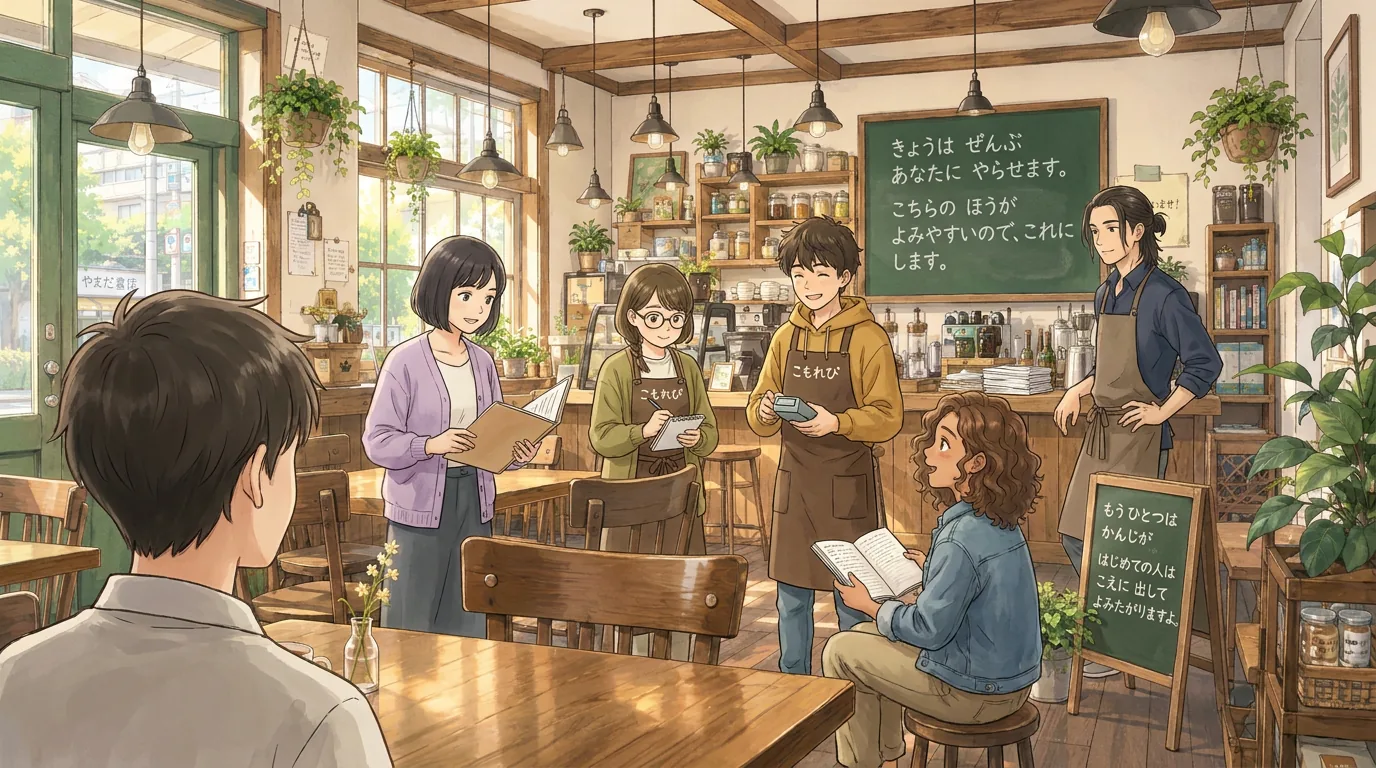
Take the ます stem and add やすい or にくい: よみやすい, つかいにくい. The result is an い adjective and behaves like one — よみやすかった, よみやすくない. It describes the thing, not the person, so it is the polite way to say a form is confusing or a chair is uncomfortable without blaming anybody present.
〜たがる: what somebody else wants
たい describes your own wish and cannot be used flatly about a third person; たがる can. Take the ます stem and add たがる, then conjugate it as a verb: 「よみたがります」, 「行きたがっています」. It carries a faint sense of watching from outside, so it is fine about learners in general and worth avoiding about the person you are speaking to.
Running a session in N4 Japanese
Everything the front of the room needs is now in hand. Open with 「はじめます」. Hand out with 「くばります」 or 「どうぞ」. Explain a choice with し or ので. Say what will be easy with やすい, what the group tends to want with たがる, and close with 「おわります。おつかれさまでした」. None of it is advanced Japanese. All of it is N4.
The scene itself is in the app.
Lesson one of this track is free to read in full. From lesson two on, the story, the audio and the review are part of a free account.