Lesson 18 of 24
Already Done, And Done For
about 12 minutes
After this lesson you can
- Say that something has been done and is still that way.
- Admit that something is finished, or has gone wrong.
Words this lesson teaches
- はります
- sticks up, posts
- おしらせ
- a notice, an announcement
- まめ
- a bean, coffee beans
- つかいます
- uses
- ふくろ
- a bag
- わすれます
- forgets
- こわします
- breaks something
- ゆうべ
- last night
What it explains
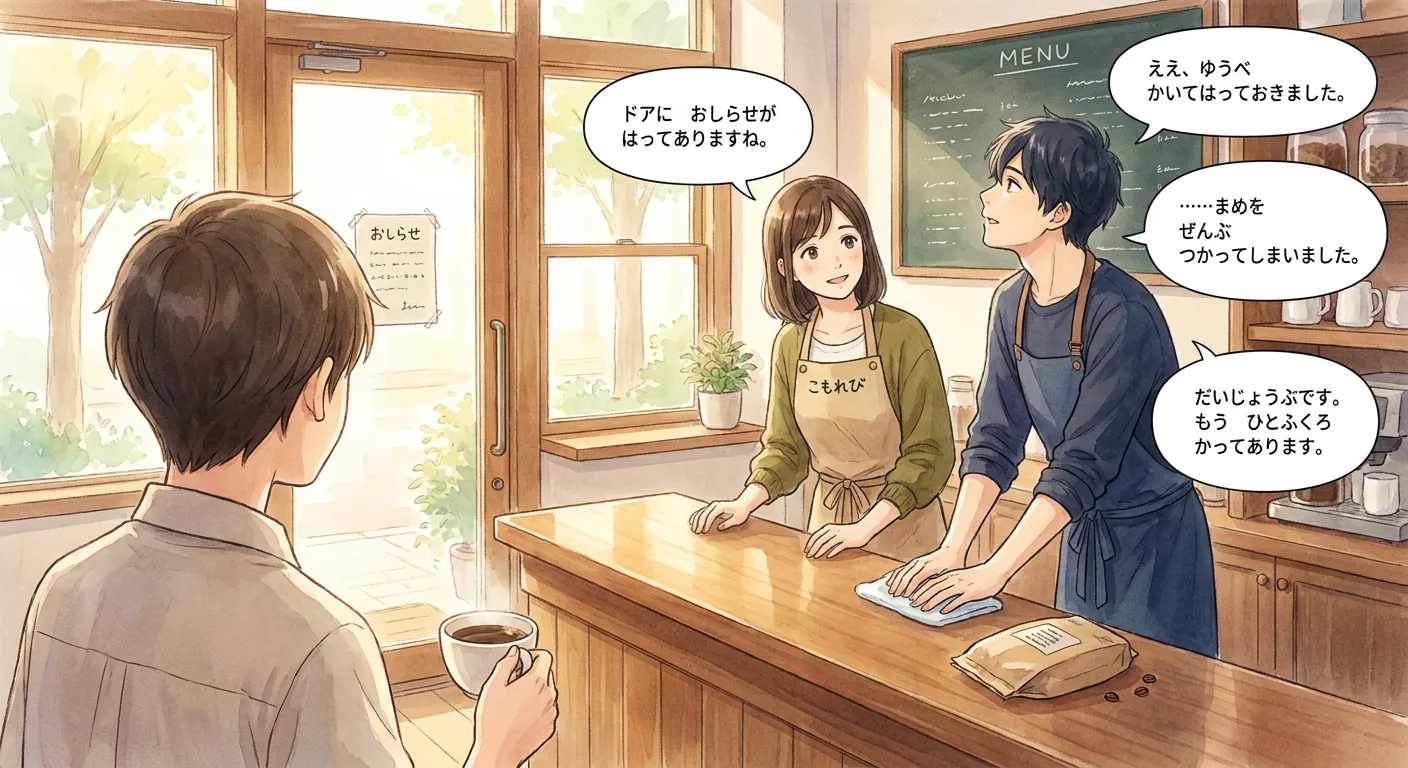
〜てある: somebody arranged this
Transitive verb plus てある. It describes a present state that resulted from a deliberate action, and the doer drops out of the sentence: 「かってあります」 — it has been bought, we are covered, never mind by whom. Compare 〜ておく, which looks forward to the same state from before it exists.
〜てしまう: finished, and often regretted
The て form plus しまう, to put away. It marks an action as complete, and very often as one the speaker wishes had gone otherwise: 「わすれてしまいました」 is not merely I forgot, it is I forgot and I am sorry about it. Without the regret it simply means all the way through: 「よんでしまいました」, I finished the book. In speech it contracts to 〜ちゃう.
The scene itself is in the app.
Lesson one of this track is free to read in full. From lesson two on, the story, the audio and the review are part of a free account.